Intro & Preface & Contents
Previous: Winter XXV. The virtue of being self-centered
Impatient for the light of spring, I have slept lately with my blind drawn up, so that at waking, I have the sky in view. This morning, I awoke just before sunrise. The air was still; a faint flush of rose to westward told me that the east made fair promise. I could see no cloud, and there before me, dropping to the horizon, glistened the horned moon.
The promise held good. After breakfast, I could not sit down by the fireside; indeed, a fire was scarce necessary; the sun drew me forth, and I walked all the morning about the moist lanes, delighting myself with the scent of earth.
On my way home, I saw the first celandine.
So, once more, the year has come full circle. And how quickly; alas, how quickly! Can it be a whole twelvemonth since the last spring? Because I am so content with life, must life slip away? Time was when a year drew its slow length of toil and anxiety and ever frustrate waiting. Further away, the year of childhood seemed endless. It is familiarity with life that makes time speed quickly. When every day is a step in the unknown, as for children, the days are long with gathering of experience; the week gone by is already far in retrospect of things learnt, and that to come, especially if it foretell some joy, lingers in remoteness. Past mid-life, one learns little and expects little. To-day is like unto yesterday, and to that which shall be the morrow. Only torment of mind or body serves to delay the indistinguishable hours. Enjoy the day, and, behold, it shrinks to a moment.
I could wish for many another year; yet, if I knew that not one more awaited me, I should not grumble. When I was ill at ease in the world, it would have been hard to die; I had lived to no purpose, that I could discover; the end would have seemed abrupt and meaningless. Now, my life is rounded; it began with the natural irreflective happiness of childhood, it will close in the reasoned tranquility of the mature mind. How many a time, after long labour on some piece of writing, brought at length to its conclusion, have I laid down the pen with a sigh of thankfulness; the work was full of faults, but I had wrought sincerely, had done what time and circumstance and my own nature permitted. Even so may it be with me in my last hour. May I look back on life as a long task duly completed -- a piece of biography; faulty enough, but good as I could make it -- and, with no thought but one of contentment, welcome the repose to follow when I have breathed the word “Finis.”
Alpha.
Amen to that.
This has turned out to be a bigger project than I imagined at the outset, Blogger tells me there are now 153 posts (and you will be surprised to learn that I haven't even published everything I've written, since I simply couldn't find a place for some of my topics). But this has also been more satisfying, and thought provoking, than I had expected.
I'm especially fond of my section titles -- Gissing simply numbered the sections -- and "Relativity of time" is a natural enough title given the text, but it has, for me, an additional virtue. Gissing completed The Private Papers of Henry Ryecroft in 1901 and it was published in 1903. In 1905 Albert Einstein published his Annus Mirabilis papers including the papers on special relativity -- the equivalence of matter and energy (E = mc2) -- plus a paper contributing to quantum theory. Time would continue to be experienced as relative, just as Ryecroft describes it but, within just two years of Gissing's death, our understanding of time and light and the very substance of reality would shift forever. With that in mind, Ryecroft above is saying “Finis” to more than just an entertaining book or life. This is “Finis” to an entire way of viewing the world.
Before we reach my final indulgence, I want to report on the literary ads that follow the Index in my old edition of The Private Papers of Henry Ryecroft. One page lists Modern Biographies for Tolstoy, Verlaine, Lafcadio Hearn, J.M. Synge, W.E. Henley, Mahommed, and Paul Bouget. The next page features Philosophies Ancient and Modern including Early Greek Philosophy, Stoicism, Plato, Scholasticism, Hobbes, Locke, Nietzsche, Berkeley, Epicurus, and "Manicheeism." The following page covers Religions like Hinduism, Early Buddhism, Magic and Fetishism, The Psychological Origin and Nature of Religion, Pantheism, Early Christianity, and Islam. Then comes The Works of George Meredith; Mary Johnston's Romances; and Pocket Editions of Famous Books (Ryecroft is the only title I recognize here). The penultimate page flogs Constables' Sixpenny Novels including titles by Bernard Shaw, Tolstoy, Gissing, and Upton Sinclair. And finally there are the Works of Bernard Shaw.
While putting this together, I just discovered yet another online version of this book in a very nice format. See here. And now for some final topics that I couldn't fit in elsewhere:
I titled this section “The Fog of War” and not “von Clausewitz” because I was determined to limit myself to just this one crucial concept -- that, alone, would be a sufficient support for the man’s reputation. But, alas, talking about this leads inexorably into a discussion of what makes a good commander. It was the opinion of Clausewitz, that a good commander shouldn’t be too intelligent. Intelligent people tend to be analytical and want to make their decisions based on the facts, precisely what the battlefield commander can’t do. The successful commander is more likely to have an intuitive sense of what to do, which is very much like saying that he has good luck. We are left here with the option of seeing the commander as a lucky gambler -- the crass alternative -- or as a kind of mystic, able to intuit the true state of affairs on the battlefield and know how to respond to it. Clausewitz's book is titled On War, but, as I tend to favor the second, more mystical interpretation, I would rather he had titled it “The Art of War” -- because it is, in this sense, less a science and more of an art... but then that title had already been taken by Sun Tzu thousands of years earlier.
Fog of War.
I’ve mentioned Karl von Clausewitz before, I believe with reference to the cholera epidemics of the mid-nineteenth century. Most people have probably heard his name and, as with Quantum Mechanics, most people have probably heard one idea connected with Clausewitz -- the Fog of War. Briefly stated, this is the notion that the commander never knows, because of the chaos of the battlefield, all the facts he would wish to know before making command decisions. In every other field, the person in charge hopes to have all the facts in hand before making his decision. Often this decision maker actually knows less than they think they know, but this is the ideal. On a battlefield, Clausewitz noticed, and taught in his book (sadly only a draft of a book as cholera finished him before he finished the book), the commander never knows all the facts. Much is concealed from him by literal or figurative smoke and, even worse, some of what he thinks he knows is almost certainly false. And yet he has to make a decision, and he has to make it right now. To dither is almost always the worst possible option (of course there are exceptions).
I titled this section “The Fog of War” and not “von Clausewitz” because I was determined to limit myself to just this one crucial concept -- that, alone, would be a sufficient support for the man’s reputation. But, alas, talking about this leads inexorably into a discussion of what makes a good commander. It was the opinion of Clausewitz, that a good commander shouldn’t be too intelligent. Intelligent people tend to be analytical and want to make their decisions based on the facts, precisely what the battlefield commander can’t do. The successful commander is more likely to have an intuitive sense of what to do, which is very much like saying that he has good luck. We are left here with the option of seeing the commander as a lucky gambler -- the crass alternative -- or as a kind of mystic, able to intuit the true state of affairs on the battlefield and know how to respond to it. Clausewitz's book is titled On War, but, as I tend to favor the second, more mystical interpretation, I would rather he had titled it “The Art of War” -- because it is, in this sense, less a science and more of an art... but then that title had already been taken by Sun Tzu thousands of years earlier.
Memory.
The subject of memory has come up quite a number of times in this blog, but I’m going to talk about it once more. There is an interesting use of the term “memory” to describe the way a traffic slowdown, on a freeway for example, radiates back in space and forward in time -- so that cars often will come to a near standstill miles behind an accident that has already been cleared away. If you are in a car approaching this “wave” of congestion there is no way to “see” the cause of it. It is simply a remnant of an earlier event.
I’ve long speculated that there is a kind of memory event in a neighborhood -- I’m thinking of the kind of suburban neighborhood where I grew up, but I imagine this to be a universal phenomenon -- in which information is passed on, year by year and generation by generation, in a static process. Mostly this concerns children’s games (though “game” here should be defined in the most generous way). The slightly older children pass on lore -- rules or secrets or something -- to the younger children who then, a few years later, pass that information on to still younger children. Where in the traffic example the memory wave moved backwards up the roadway and forward in time, this wave is fixed in place and at a certain age (or age differential) of children.
Undoubtedly there are similar standing wave patterns relating to young adults moving into a neighborhood and buying and learning to maintain houses. Or to elderly people making the transition into a compromised state of decrepitude and dependence (in a retirement home or nursing home, for example.)
There was probably something else I wanted to add to this, but I forget.
In the end, music.
To play us out, I will introduce you to a game we used to play in my online community: What are the next 10 songs played by your iPod on shuffle? I thought of this some time ago and recorded the first 10 songs my iPod played. I thought I might do that a couple times and then choose the best of the bunch, but I'm really pleased with the original batch, so here they are. Rather than fill the page with YouTube windows, I'll let you click the song title to go to a song if you so choose: Iris Dement, “The Way I Should” ; James Taylor, “Carolina In My Mind” ; John Lee Hooker, “Annie Mae” ; Alison Krauss and Union Station, “Bright Sunny South” ; Nat King Cole Quartet, “Sweet Lorraine” ; Evanescence, “Going Under” ; Natalie Merchant, “It Makes a Change” ; Patsy Cline, “She’s Got You” ; Eddie Harris & Les McCann, “Kathleen’s Theme” ; The Cranberries, “Zombie”.
Were I to pick the songs, instead of letting my iPod decide, I wouldn't have chosen some of these artists. And, given these artists, I wouldn't have picked these particular songs. But I love this mix of artists (including at least two I've mentioned before: Nat King Cole and Eddie Harris & Les McCann.) And even the songs I would never have selected myself are perfect in their own way. These ten songs cover 1990s folk, 1960s folk rock, blues, traditional bluegrass, 1940s jazz, 2000s gothic metal, 2000s hard to define, 1950s crossover country, 1960s jazz, 1990s rock. I am a little surprised there's nothing from the 1970s or 1980s, but there are several songs from just before and one from just after.
And, just now, I noticed something I hadn’t thought of previously. Two of the Double Wasp powered aircraft I didn’t mention earlier were the B-26 and A-26. Since, later in the war, these types were used exclusively in Europe, along with the bulk of the P-47s, engine logistics within the U.S.A.A.F. were simplified by what I always assumed was a decision based on the disinclination of pilots in the Pacific to fly the B-26 and A-26. That may have been a battle the U.S.A.A.F. was only too happy to let the pilots win.
A Tale of Two Engines.
This should have come before the music section, but I'm so certain of my losing any audience (that has even made it this far) with this final indulgence, that I wanted the music to have some chance of being seen.
When I used to workout in the early afternoon, it seemed there were always History Channel documentaries about WW2 on at least one screen at my gym. Regardless of the particular subject of the documentary, there was always footage of the Battle of Stalingrad. There are, in fact, endless interesting stories you can tell about that battle, but modern wars are actually won by more prosaic things -- like very high octane aviation gasoline and superior aircraft engines.
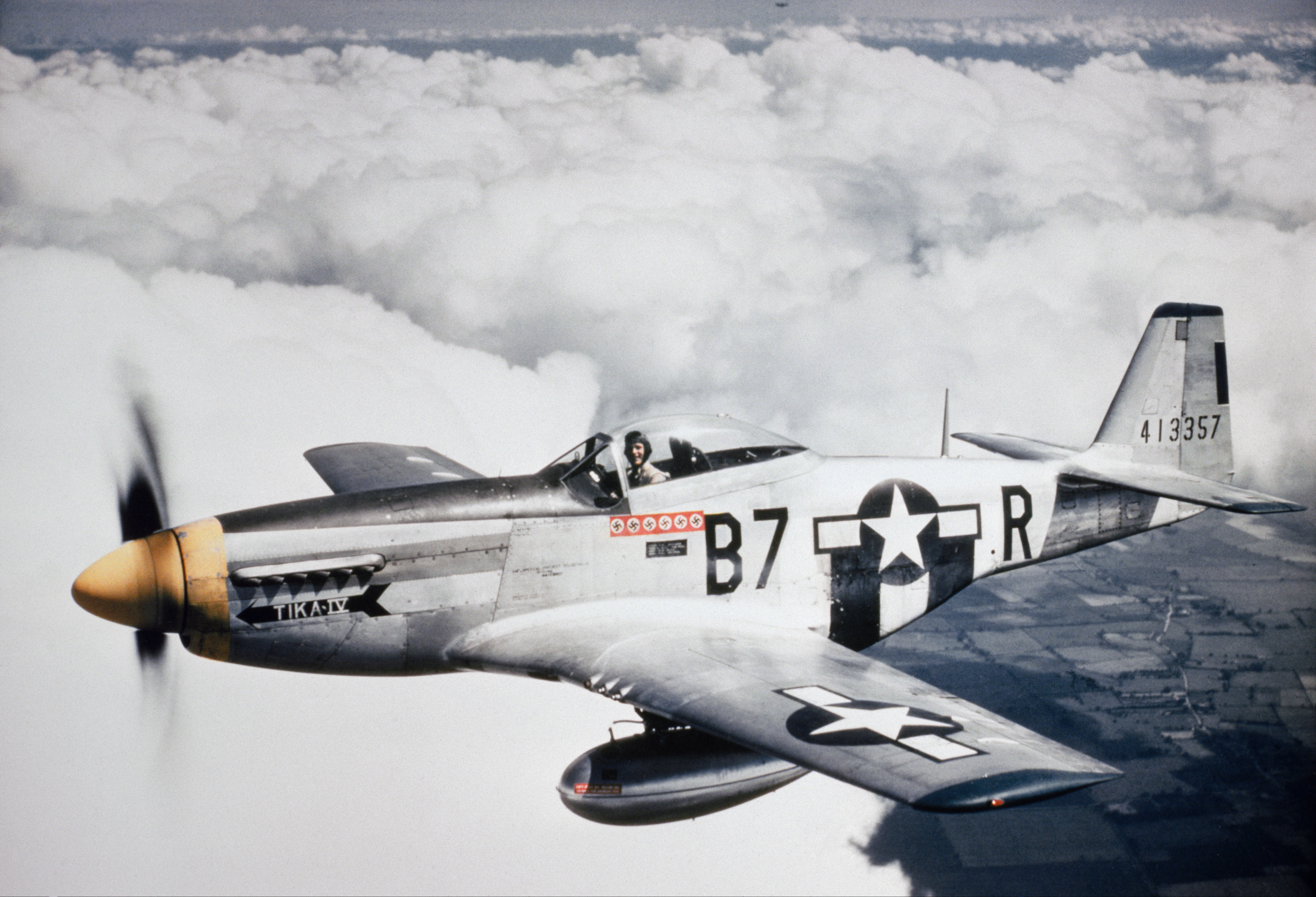
The U.S. Army Air Force began the war with a bunch of sleek, planes (the P-38, P-39, P-40, and P-51) all powered by the same V-12, liquid-cooled engine, the Allison V-1710. Only the P-38, with two turbo supercharged engines, had adequate power for competing with enemy fighters. The P-39 and P-40 were either used in secondary theaters of the war or given to desperate allies. The P-51 Mustang originally found a home with the British, desperate for anything that could fly, who thought to replace the Allison engine with a Rolls-Royce Merlin. The Merlin, which powered the Spitfire, Hurricane, and the Mosquito, produced over 1,000 horsepower on 100 octane fuel near the start of the war and by the end of the war Merlins were generating over 2,500 HP on 150 octane fuel in tests. Also by the end of the war, P-51s were supplied with a Packard built version of the Merlin which, along with drop tanks (made of paper) to extend range and a new bubble cockpit (to improve visibility), made the P-51 arguably the best pure fighter of the war.
But what I want to talk about is the Pratt & Whitney R-2800 Double Wasp. This was an old-school, air cooled 18 cylinder radial that started with 2,000 hp and worked up to 2,400 late in the war -- and this was routine use rather than just in tests. The Double Wasp powered the USAAF P-47 and the U.S. Navy F4U Corsair and F6F Hellcat (plus a bunch of two-engined types). These are not pretty aircraft (though the Corsair is at least distinctive) but they were, for the time, powerful and rugged -- air cooled engines are much more forgiving of damage than are liquid cooled engines. You can shoot up a Double Wasp, even destroy a cylinder or two, and the thing will keep flying. Poke a single hole in the cooling tubes of a Merlin or Alison and the engine will quickly freeze up.
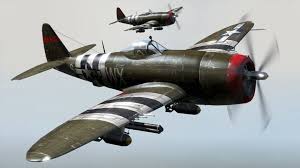
The Corsair, and especially the Hellcat, won the air war in the Pacific, while the P-47, with eight (rather than the usual six) .50 caliber machine guns in its wings, was the most feared fighter-bomber in either theater. I read a story about an RAF squadron that was switched from Spitfires to P-47s late in the war. The pilots were depressed when they first saw their new mounts -- no one ever called the P-47 Thunderbolt, nicknamed the “Jug”, a pretty aircraft -- but they were quickly won over. While lacking the grace and beauty of the Spitfire, the Thunderbolt could perform tasks -- like bombing and strafing -- that a Spitfire either couldn’t or shouldn’t perform. And when pressed into aerial combat, they could hold their own against the best (piston powered) planes the Germans could field. And in WW2, if tanks had become the new heavy cavalry, fighter-bombers like the P-47 had become the new light cavalry -- making quick and devastating strikes hundreds of miles behind enemy lines.
And, just now, I noticed something I hadn’t thought of previously. Two of the Double Wasp powered aircraft I didn’t mention earlier were the B-26 and A-26. Since, later in the war, these types were used exclusively in Europe, along with the bulk of the P-47s, engine logistics within the U.S.A.A.F. were simplified by what I always assumed was a decision based on the disinclination of pilots in the Pacific to fly the B-26 and A-26. That may have been a battle the U.S.A.A.F. was only too happy to let the pilots win.
